
Getting Started: Step-by-Step
- See bank and credit union branch locations in your area on the Accounts page Google Map available at this link. Click on the search symbol (looks like a magnifying glass) in the red box and enter your zip code to see which banks and credit unions with a Bank On certified account (the different color pins) are in your zip code and surrounding area. Clicking on a colored pin will provide the name of the bank or credit union, the name of the account to ask for, and a link to more account information on the bank or credit union website.
- Prefer to search by bank or credit union? Scroll down on the Accounts page at this link and click on the Bank On Certification Seal for the bank or credit union you are interested in under the Certified Accounts In Our Area section.
- List the bank and credit unions that are of interest. IMPORTANT: Remember to also write down the account name.
- Look on Chart – Account Features / ATM Fees to see account details for Bank On New Mexico financial institution partners on an easy-to-view chart. ATM fees, age requirements, monthly fees, and more can be found here.
- See Chart – Alternative Identification Accepted if you would like to see types of documentation accepted. Primary identification must include a photo, and also required is documentation showing an address which cannot be a PO Box. The most easily accepted are government identification, such as a driver’s license or state ID.
- Call the bank or credit union you’ve selected to ask about their Bank On certified checking account. Remember that each bank and credit union have a different name for their Bank On account and that it will be important to know which account. Call more than one to compare.
- Confirm with the bank or credit union on what to bring or what is needed to open an account. Typically, at least 2 forms of identification are requested along with a Social Security number or ITIN number. Keep in mind that financial institutions can be flexible on what they accept and it can be worthwhile to ask if there are other documents they accept that are not on the Alternative Identification Accepted Chart.
- Schedule an appointment once you decide which bank or credit union you would like to open your account at. If they have an online application process can apply online and follow up with a visit to their branch or a phone call if needed.
- Read all the terms and conditions before signing for your new account, If there is something you don’t understand, remember it is always ok to ask questions.
Frequently Asked Questions
Will I be able to view my bank or credit union accounts information on my phone?
Yes! That’s a good habit to start and most banks and credit unions have a mobile app for logging in on your phone to check your balance, confirm your deposits, and to verify where you spent your money.
Can I send money electronically to my family and friends?
Yes. Most credit unions and banks have a mobile banking app that use a free payment platform like Zelle or iPay to send money to your friends or family easily and quickly.
Connecting digital wallets like Cash App, Venmo, Paypal, or Apple Wallet, is also an option and recommended for making purchases or sending funds to someone you don’t know. IMPORTANT: Be sure to connect to your debit card and not directly to your checking account. If any fraud happens it is easier to replace and change your debit card number instead of starting over with a new account.
Can I get cash from my account when the bank or credit union is closed? I don’t want to be carrying too much cash around.
Yes. Banks and credit unions have ATM machines or are part of a shared network where you can withdraw cash safely when you need it. Check the website for the bank or credit union you are considering to see their in-network ATM locations if this is something that is important for you.
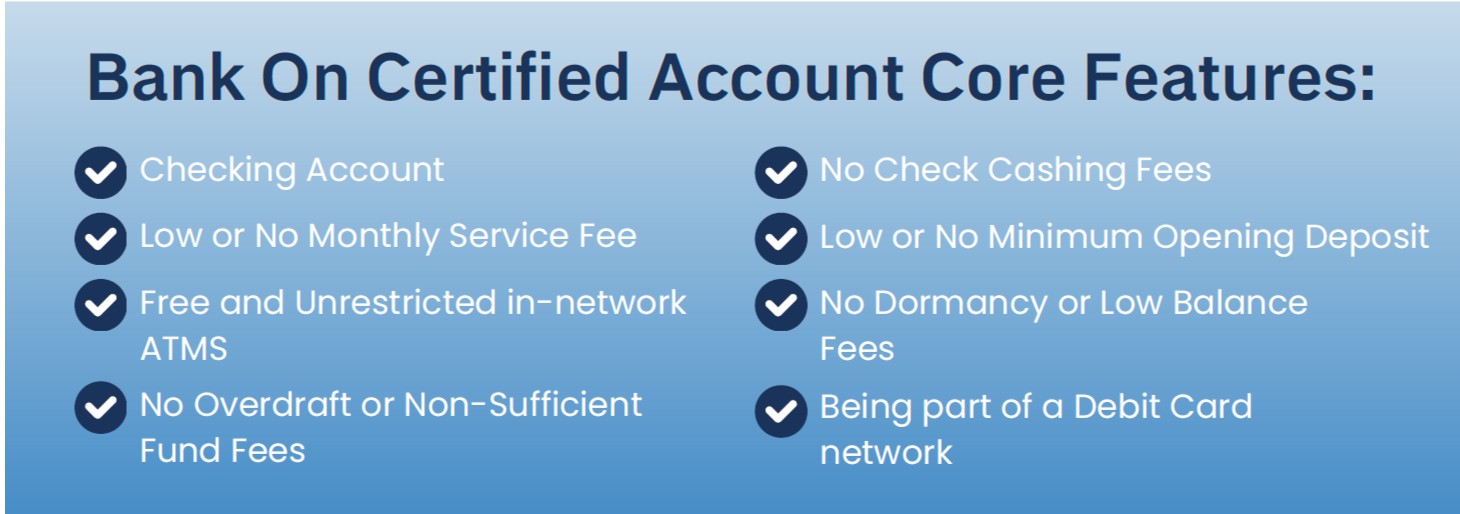
Remember that Bank On certified accounts DO NOT have in-network ATM fees. Access is free and unrestricted in-network.
In-network means that the ATM is owned by the financial institution you bank with or is part of a CO-OP or network. See Chart – Account Features / ATM Fees for out-of-network fees.
What are some other reasons for me to build a financial relationship with a bank or credit union?
Your money is insured which means that if the bank or credit union were to close your money is guaranteed safe.
Your funds are protected from fraud and if your account information or debit card is stolen a bank or credit union representative is there in person at a branch close to you to help figure things out and get you back on track.
This can be an important first step in reaching your other financial goals such as getting an emergency or car loan, or building your savings account for other purchases and big occasions.